
Abuja · September 2026
One Nigeria Movement: Building a National Political Bridge from Abuja to the Grassroots
Inside the structure, vision and national mobilisation behind the movement led by Hon. Umar Bello Jada (Calculate)
By Hassana Ozohu Salisu · National Publicity Secretary, One Nigeria Movement
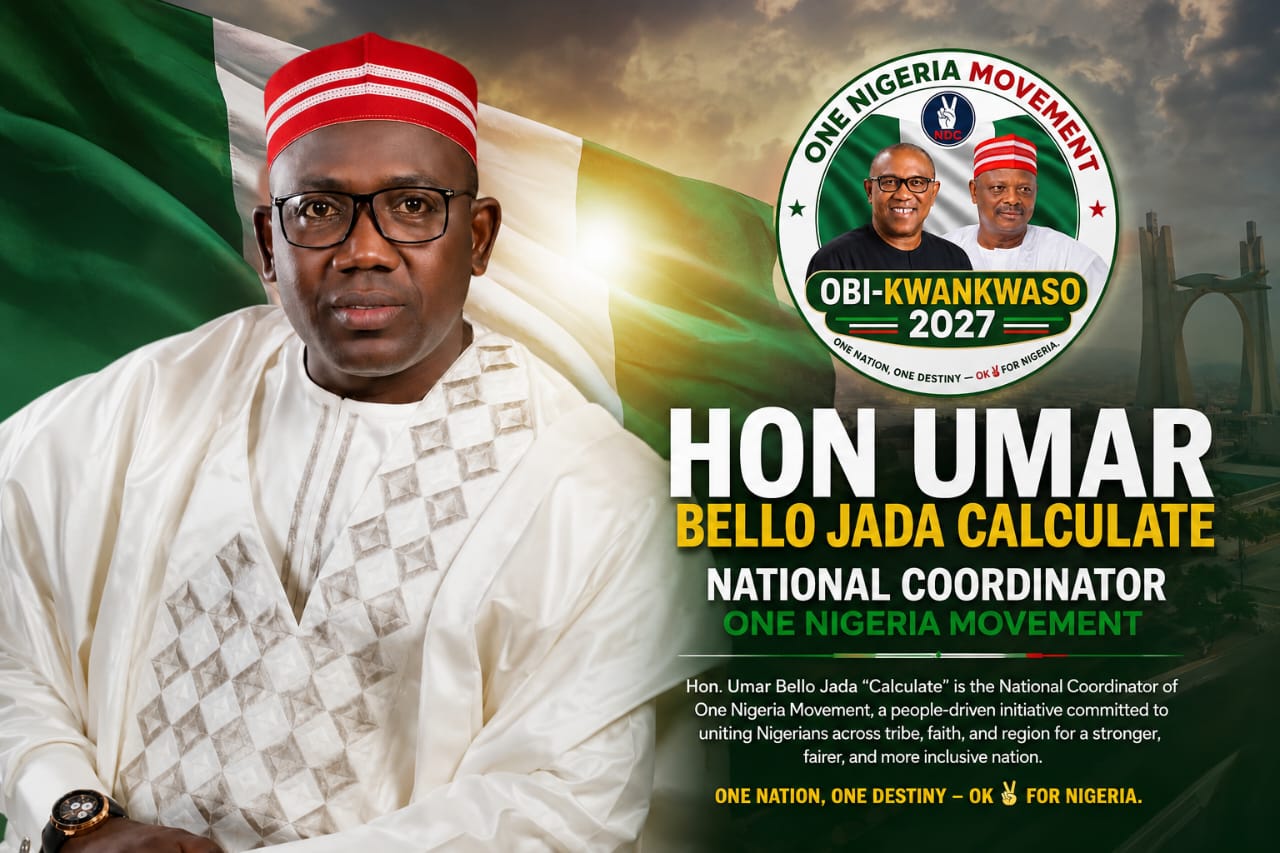
At a time when Nigeria's political space is increasingly defined by debates over regional interests, political structures and competing organisations, the One Nigeria Movement (ONM) is presenting a distinctly national message: that Nigeria's diversity can become a foundation for political cooperation rather than division.
“One Nation, One Destiny, One Purpose, One Nigeria.”
According to the movement's published mission, ONM seeks to promote national unity, inclusion, youth participation, responsible citizenship, leadership development and sustainable national development. Its stated vision is of a Nigeria in which citizens are treated as equal Nigerians regardless of ethnicity, religion or region.
A National Secretariat in the Heart of Abuja
The movement's national office is listed at 81 Ralph Shoreside Street, Central Business District, Abuja, Nigeria. The official contact page identifies the location as the national office and lists Hon. Umar Bello Jada as the national contact.
The choice of Abuja is symbolically significant for an organisation whose stated objective is to build a national platform. Abuja, as Nigeria's Federal Capital, provides a central point from which a movement with national ambitions can coordinate engagement across the country's regions.
The movement's public materials describe its organisation as a grassroots platform designed to connect citizens across Nigeria's regions, professions, generations and communities.
Umar Bello Jada: The Man Behind the Movement
At the centre of the One Nigeria Movement is its Founder and National Coordinator, Hon. Umar Bello Jada, popularly known as “Calculate.”
The movement's official profile describes Jada as a politician, political strategist and grassroots mobiliser with more than four decades of political engagement, and identifies national unity and inclusive governance as central to his public mission.
Jada's approach, as presented by the movement, is based on the belief that Nigeria's political future cannot be built by one region acting alone.
It must involve the North. The South. The East. The West. Muslims. Christians. Young people. Women. Professionals. Community leaders. And ordinary Nigerians who want to participate in determining the country's future.
That philosophy is reflected in the structure the movement says it has been building.
A Structure Designed to Look Like Nigeria
One Nigeria Movement says its national leadership has been deliberately constituted to provide broad national representation.
Its published leadership structure includes Prince Peter C. Okoronkwo as National Secretary, Alhaji Ali Abacha as National Organising Secretary, Alh. Dr. Obinna Simon (Tagwaye) as National Publicity Secretary, Amb. Muhammad Auwal Musa as Deputy National Coordinator — North, and Hon. Engr. Francis Nnoli as Deputy National Coordinator — South, alongside other national officers and patrons.
The structure also includes roles covering administration, organisation, publicity, digital media, regional coordination and grassroots mobilisation.
That architecture reflects the movement's stated intention to operate beyond the personality of a single leader and develop an organisational network capable of engaging Nigerians at different levels.
Its stated programmes include community outreach, youth empowerment, leadership and capacity-building, public enlightenment, networking, mentorship, conferences, town halls and community-development activities.
The North–South Bridge
Perhaps one of the most politically significant elements of the movement's structure is its explicit effort to create cooperation across regional lines.
The movement's published mission specifically identifies bridging traditional North–South political divides as one of its objectives. It also emphasises religious tolerance, equal citizenship and inclusive national representation.
That philosophy is particularly relevant to the political project around Peter Gregory Obi and Rabiu Musa Kwankwaso, which the movement describes as a proposed partnership intended to serve as a vehicle for greater national unity and political reconciliation between regions and constituencies.
The Obi–Kwankwaso Mandate
The One Nigeria Movement identifies itself as the Obi–Kwankwaso Movement 2027 (OK) and publicly associates its national mobilisation with the proposed Obi–Kwankwaso political partnership.
Its official website identifies Peter Obi as Presidential Candidate, NDC, and Rabiu Kwankwaso as Vice Presidential Candidate, NDC.
For ONM, the political significance of the proposed ticket goes beyond the names of two politicians. The movement frames it as an opportunity to demonstrate that political cooperation across regional and religious lines is possible.
That is the central political narrative behind its mobilisation. And it is also where Jada's organisational work becomes important: building a structure capable of carrying that message beyond political headquarters and into communities.
The Sacrifice Behind the Structure
Building a national movement requires more than banners, meetings and social-media announcements.
It requires people willing to spend time travelling, organising meetings, coordinating volunteers, communicating with stakeholders and maintaining relationships across different communities.
The One Nigeria Movement credits Jada with providing the leadership behind that organisational effort.
A report published in August 2026 said Senator Rabiu Musa Kwankwaso visited the movement's national secretariat and publicly commended Jada for what he described as his patriotism, leadership and commitment to national unity. The report also quoted Jada as describing the movement's work as an effort to bridge Nigeria's political, ethnic and religious fault lines.
Those remarks should be understood as attributed statements, rather than independent assessments of Jada's political record.
But they illustrate how the movement itself wants its story to be understood: as an organisation whose leadership has invested substantial effort in building a national platform around unity.
More Than an Inauguration
The forthcoming inauguration is therefore being positioned not merely as another political gathering.
It represents a public presentation of the structure that ONM says it has been developing.
For the movement, the challenge after the inauguration will be to translate its philosophy into sustained grassroots engagement: maintaining its state structures, communicating consistently with members, engaging young Nigerians, encouraging peaceful political participation and demonstrating that its national-unity message can operate beyond Abuja.
That is where the real test of any political movement ultimately lies—not simply in the size of an inauguration crowd, but in the strength, discipline and continuity of the organisation that follows it.
One Nigeria, One Political Conversation
The story of One Nigeria Movement is ultimately a story about an idea: Can Nigerians from different regions, religions and backgrounds organise around a common national political purpose?
Hon. Umar Bello Jada and the structure he leads say the answer should be yes.
Their platform places national unity, inclusion, grassroots participation and the Obi–Kwankwaso political project at the centre of its current mobilisation.
As the movement prepares for its September 26, 2026 inauguration, attention will increasingly turn from its message to its ability to demonstrate that message through organisation.
From its Abuja national office to its emerging grassroots structures, ONM is seeking to make one argument unmistakable:
“Nigeria's future cannot belong to one region. It must belong to Nigerians.”
One nation. One destiny. One purpose. One Nigeria.
Hassana Ozohu Salisu
National Publicity Secretary, One Nigeria Movement